
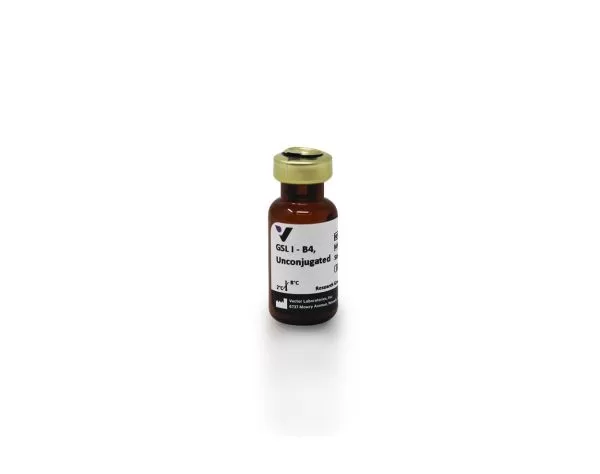
GSL I-B4 isolectin contains only the B subunits. It is a useful marker for endothelial cells from nonprimates such as mouse, rat, rabbit, and goat as well as a marker for non-peptidergic unmyelinated primary afferent neurons. This “B”-rich lectin preferentially agglutinates blood group B cells and is specific for α-galactose residues.
| Unit Size | 1 mg |
|---|---|
| Applications | Immunohistochemistry / Immunocytochemistry, Immunofluorescence, Blotting Applications, Glycobiology |
| Recommended Usage | Although many buffers can be employed for reconstituting and diluting this lectin, 10 mM HEPES buffered saline, pH 8.5, 0.1 mM CaCl2 is recommended.For preserving solutions, stored at 4 ºC, 0.08% sodium azide can be used. |
| Recommended Storage | 2-8 °C |
| Conjugate | Unconjugated |
| Sugar Specificity | Galactose |
GSL I is a family of glycoproteins with molecular weights of approximately 114 kDa. There are two types of subunits, termed A and B, with slightly different molecular weights. These subunits combine to form tetrameric structures, resulting in five isolectins. The A -rich lectin preferentially agglutinates blood group A erythrocytes and thus appears to be specific for α-N-acetylgalactosamine residues, while the B -rich lectin preferentially agglutinates blood group B cells and is specific for α-galactose residues. Our GSL I is a mixture of the five isolectins. GSL I has been reported to bind several glycoproteins including laminin.
Inhibiting Sugar: 500 mM galactose or 100 mM raffinose

 Powered by Bioz © 2023